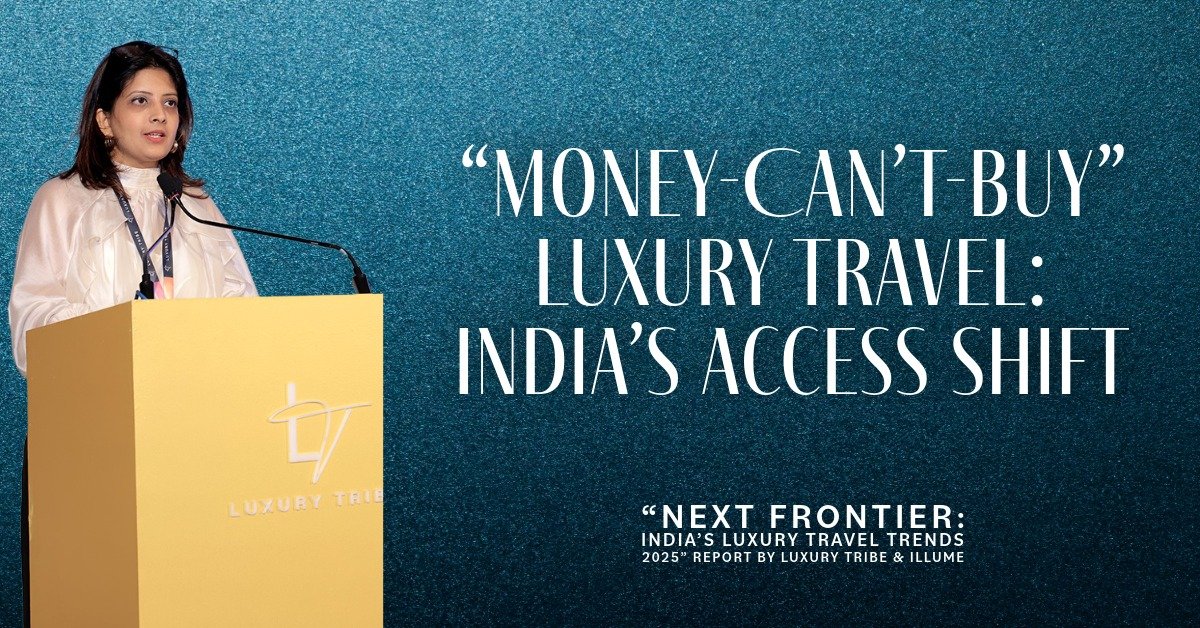
From Five-Star to First Access: How Luxury Is Now Defined by Entry, Not Opulence
Analysis from report: “Next Frontier: India’s Luxury Travel Trends 2025” is the definitive industry report on the evolving preferences and spending behaviour of India’s affluent outbound traveller. Commissioned and published by Luxury Tribe, this landmark report is grounded in exclusive insights gathered over three months through a structured survey of 120 of India’s most influential luxury travel designers—those who directly manage the bespoke travel plans of the country’s high-net-worth individuals and ultra-high-net-worth families.
This Analysis Covers
- “Money-can’t-buy” experiences
- Private safaris, behind-the-scenes access, closed-door experiences
- Why accommodation is now the gateway, not the goal
The global luxury travel industry has a habit of reducing the Indian luxury traveller to a familiar set of signals: premium hotels, iconic cities, brand-name shopping streets, and the comfort of predictability.
Those signals still exist. But the centre of gravity is shifting.
The “Next Frontier: India’s Luxury Travel Trends 2025” report indicates that the Indian luxury traveller is increasingly motivated by “unique experiences” and high-value upgrades that change the quality of the journey—not just its price tag. Luxury accommodations remain central, but the definition of what makes a journey “worth it” is evolving toward something more specific: access.
Not access as a buzzword. Access as a behavioural truth—measured in how Indian UHNWIs and HNWIs choose destinations, plan journeys, and allocate spend when the goal is not merely comfort, but distinction.
1. The shift is not from hotels to experiences—it’s from “availability” to “entry”
The “Next Frontier: India’s Luxury Travel Trends 2025” report makes one point repeatedly clear: accommodation is still the foundation. Spending allocation continues to lean heavily toward stays, and suite upgrades remain the most demanded add-on—proof that the “home base” is still what luxury travellers pay for first.
But here is what has changed: The hotel is no longer the headline. It is the platform. Indian luxury travellers increasingly use the property as:
- a trusted environment,
- a service engine,
- and a gateway to what happens beyond the lobby.
Which means the property is judged not only by its physical luxury, but by its ability to open doors:
- private access to places,
- discreet movement,
- controlled visibility,
- and moments that do not feel mass-produced.
This is why “unique experiences” rank close behind luxury accommodations as destination-selection drivers in the report, while logistical ease matters—but does not dominate. The traveller will tolerate complexity if the payoff is meaningfully differentiated.
2. “Unique experiences” is not a category—it’s a new status language
Luxury has always contained status. But the status language is changing. Traditionally, status signalled itself through recognisable markers: iconic hotels, first-class cabins, famous destinations, known luxury codes.
Now, status increasingly signals itself through story quality:
- what you accessed,
- what you experienced privately,
- what was curated for you,
- what wasn’t available to the general public.
This aligns with multiple threads in the “Next Frontier: India’s Luxury Travel Trends 2025” report:
- the high demand for adventure and exploration as a motivator,
- the strength of remote getaways and safaris as preferred experiences,
- and the rising interest in ultra-rare journeys (including expedition-style travel).
The modern Indian affluent traveller is often not seeking “the best version of what everyone does.” They want the version that few people can do.
3. The “Access Ladder”: how Indian UHNWIs measure exclusivity
To make this actionable, it helps to define access as a ladder. Across luxury travel designers, we see access typically work in four levels:
Level 1: Priority (faster, smoother, better placement)
- priority transfers
- best tables
- preferred room locations
- early check-in / late check-out
This is expected. It improves comfort, but doesn’t create a story.
Level 2: Personalisation (designed around the traveller)
- customised itineraries
- tailored pacing
- preferences embedded into service and rhythm
The “Next Frontier: India’s Luxury Travel Trends 2025” report reflects this through strong appetite for personalised, private experiences and upgrades that meaningfully change the trip.
Level 3: Privacy (control of environment and visibility)
- private entrances
- discreet zones
- buyouts / private wings
- controlled interactions
Privacy appears as a key factor influencing trip length and destination choice—yet it doesn’t override everything else. Which tells us something important: privacy is most powerful when paired with access and convenience.
Level 4: Entry (the “not publicly available” layer)
- closed-door visits
- behind-the-scenes experiences
- private previews
- rare itineraries timed to phenomena or scarcity
This is where the Indian luxury market is moving fastest—because Entry delivers the most powerful status: not the ability to buy, but the ability to enter.
Illume Insight: In the Indian luxury market, “exclusive” no longer means expensive. It means entry: the ability to access what most people cannot.
4. Why “Entry” is rising now: three underlying behavioural forces
4.1 Celebration-led travel has raised the stakes
The report highlights celebratory travel as a major motivator. Milestones aren’t ordinary leisure. They are high-visibility, high-emotion events. That changes the requirement: the journey must feel “produced,” not assembled.
When a trip is a milestone, the family doesn’t want generic excellence. They want:
- a private moment,
- a unique reveal,
- a place that feels secured,
- an experience that cannot be repeated easily.
Entry becomes the differentiator.
4.2 The traveller is more globally fluent than stereotypes suggest
Cultural familiarity ranks low as a destination-selection factor in the “Next Frontier: India’s Luxury Travel Trends 2025” report, and a majority are open to exploring local cuisines. This tells us the traveller is not dependent on familiarity to feel comfortable; they are willing to explore—provided the experience is executed at a high standard.
A globally fluent traveller will naturally seek higher-order value. Entry is a higher-order value.
4.3 Status has moved from “visibility” to “discernment”
A quiet but crucial change: the Indian affluent traveller increasingly prizes discernment—taste, curation, restraint, rarity.
In that context, loud luxury is less impressive than smart access:
- the hidden door,
- the reserved moment,
- the itinerary that feels impossible to replicate.
This dovetails with the “Next Frontier: India’s Luxury Travel Trends 2025” report’s emphasis on privacy, seclusion, remote travel, and the growing attraction toward rare, high-story journeys.
5. What “access” looks like in purchasing behaviour (and why brands misread it)
A common mistake is to assume access is “VIP events” alone. The “Next Frontier: India’s Luxury Travel Trends 2025” report’s ranking of luxury upgrades and add-ons is instructive: suite upgrades come first, followed by adventure excursions, then private dining experiences, and then exclusive event access. This ordering matters.
It suggests that for Indian luxury travellers:
- Access is meaningful when it changes the lived experience (space, privacy, comfort, control)
- then when it creates story intensity (adventure, nature, rare settings)
- then when it creates social or symbolic value (private dining, events)
In other words, access is not just “glamour.” It is often function + story + discretion, in that order. Brands that only lead with gala invitations miss the more powerful access conversation: the access that makes the traveller feel protected, elevated, and privately served.
6. Implications for hotels, resorts, destinations, and experience partners
For hotels and resorts: stop selling luxury; start selling gateways. Your most valuable product for the Indian market is not only the room category. It is your ability to orchestrate Entry:
- partnerships that open doors
- discreet movement systems
- private zones and private pacing
- exceptional concierges with real leverage
If suite upgrades dominate demand, treat the suite not as a larger room, but as a private command centre for the journey.
For destinations: market “formats,” not brochures. Luxury travellers are choosing destinations through the lens of experience formats:
- wilderness + refinement
- city + private access
- culture + closed-door moments
- nature + guided exclusivity
Given that “unique experiences” outrank ease factors, destinations should stop over-indexing on generic highlights and focus on controlled, premium access points.
For DMCs and experience partners: build inventory that is truly scarce. Scarcity is not created by pricing. It is created by:
- limited capacity
- limited timing
- limited permission
- limited visibility
Indian UHNWIs increasingly want the kind of scarcity that feels legitimate.
7. The executive takeaway: Access is now a competitive moat
The Indian luxury traveller of 2025 is not harder to impress because they demand “more luxury.” They are harder to impress because they are increasingly asking a different question: “Can you get me in?” In a world where five-star standards are widely available, Entry is the last real differentiator. That is the access shift.
And it is why the brands that win India in the next decade will not be those with the loudest marketing—but those with the strongest ability to orchestrate private, high-integrity, high-story access at scale. “Next Frontier: India’s Luxury Travel Trends 2025”
Read Next Analysis: Why Celebrations, Not Vacations, Drive India’s Highest-Spend Travel
Read Previous Analysis: The Indian Luxury Traveller, Rewritten: What Has Fundamentally Changed
Explore the Report: /Next-Frontier-India-s-Luxury-Travel-Trends-2025/
Download the full report: email signup request
The insights, data interpretations, and perspectives presented in this article and report are proprietary to “Luxury Tribe & Illume”. They may be quoted or referenced by media and partners for editorial or analytical purposes, provided clear attribution is given to: Source: “Next Frontier: India’s Luxury Travel Trends 2025” Report by Luxury Tribe & Illume. Reproduction, redistribution, or commercial use of this material, in whole or in part, without prior written consent from Luxury Tribe, is not permitted.
Copyright © 2009-2025. Proprietary insights by Kaltenhouse Pte Ltd. All Rights Reserved.