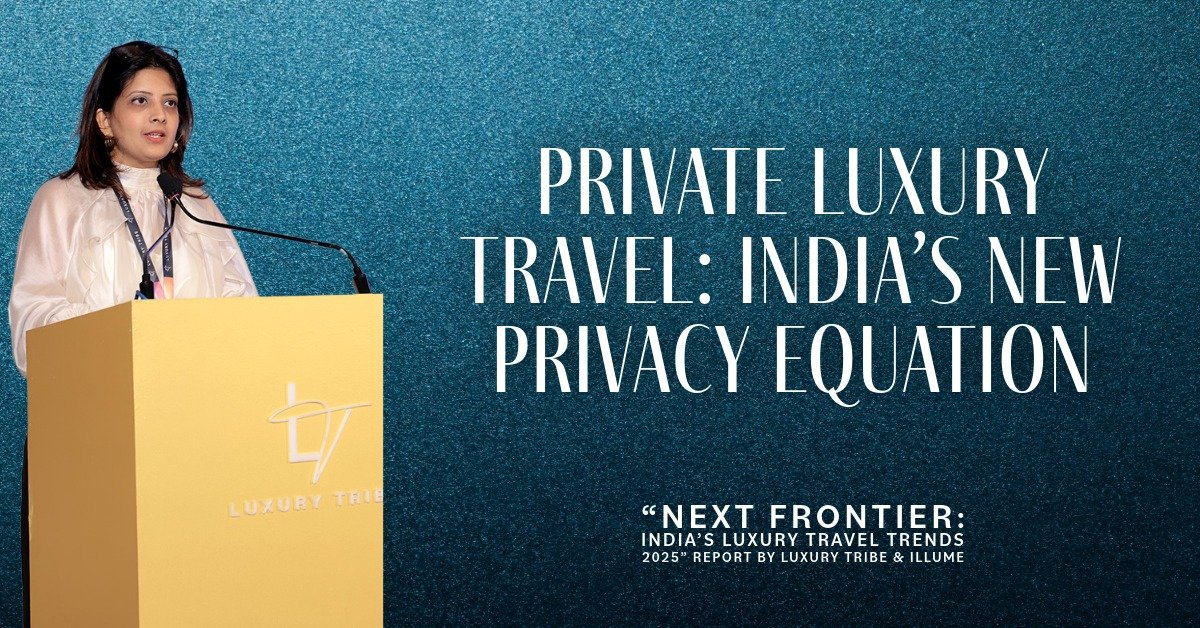
Seclusion with Service: The New Privacy Equation for Indian UHNWIs
Analysis from report: “Next Frontier: India’s Luxury Travel Trends 2025” is the definitive industry report on the evolving preferences and spending behaviour of India’s affluent outbound traveller. Commissioned and published by Luxury Tribe, this landmark report is grounded in exclusive insights gathered over three months through a structured survey of 120 of India’s most influential luxury travel designers—those who directly manage the bespoke travel plans of the country’s high-net-worth individuals and ultra-high-net-worth families.
This Analysis Covers
- Why privacy ≠ isolation
- Balance between access, location, and discretion
- Villas, private wings, managed seclusion
Luxury travel has always sold privacy. But in 2025, privacy is no longer a soft preference—something “nice to have” for select guests. For India’s affluent travellers, privacy is becoming a core operating requirement—and at the same time, it is being redefined.
The “Next Frontier: India’s Luxury Travel Trends 2025” report highlights seclusion and privacy as the most critical factor influencing trip length and destination selection. Yet, when travellers choose accommodations, the data shows something more nuanced: luxury amenities and proximity to major attractions rank even higher, while privacy and exclusivity remain important but not dominant.
This combination reveals the reality global brands must understand: Indian UHNWIs want privacy, but they do not want isolation. They want a travel experience that feels discreet, controlled, and protected—without sacrificing service depth, convenience, or access to what matters. This is the new privacy equation.
1. Privacy has become a form of luxury competence
In many luxury markets, privacy is treated as a feature: a secluded villa, a private pool, a “hidden” resort. For affluent Indian travellers, privacy is better understood as a capability:
- Can the brand protect visibility?
- Can it manage proximity without exposure?
- Can it deliver high-touch service without intrusion?
- Can it anticipate family dynamics and reduce social friction?
This is why privacy appears as a critical factor at the trip-design level. It affects not only where travellers go, but how they structure time and movement.
The traveller is effectively asking for a protected environment—one where the quality of the journey is not interrupted by crowds, unpredictability, or unwanted attention.
2. The privacy paradox: “seclusion” matters, yet “proximity” still wins
The “Next Frontier: India’s Luxury Travel Trends 2025” report’s accommodation findings are one of the clearest indicators that Indian luxury behaviour is not built around extremes. When selecting accommodation, affluent Indian travellers place very high value on:
- luxury amenities (spa, pools, wellness, fine dining),
- proximity to major attractions (shopping, key districts, landmarks),
- with privacy and exclusivity important—but not the single deciding factor.
This tells us privacy must be delivered inside convenience. A property can be central and still feel private—if it has:
- discreet arrivals,
- private elevators,
- controlled public spaces,
- segmented guest flows,
- and staff trained in discretion.
Equally, a property can be remote and still feel exposed—if service is inconsistent, spaces are shared in uncontrolled ways, or operational systems are not built for privacy. Privacy is not geography. It is design and execution.
3. What privacy means in the Indian luxury context: four dimensions
Across India’s affluent traveller base, privacy tends to express itself through four dimensions:
3.1 Visibility control. Not being “seen,” photographed, approached, or made public in any way—especially during celebratory travel, family gatherings, or high-stakes trips.
3.2 Pace control. The ability to move through a day without external interruptions. This includes flexible scheduling, no-pressure dining, and the freedom to change plans without friction.
3.3 Space control. Private zones that feel like personal territory:
- suites that function as residences,
- villas with multiple gathering areas,
- private dining settings,
- and spaces where family can be together without being “on display.”
This connects directly to why suite upgrades rank as the most demanded luxury add-on in the “Next Frontier: India’s Luxury Travel Trends 2025” report: space is not only comfort; it is privacy infrastructure.
3.4 Access control. Perhaps the most modern dimension: the ability to keep the experience “closed” to the public.
- private guides,
- private viewings,
- controlled itineraries,
- and experiences that don’t feel crowded or commoditised.
This aligns with the “Next Frontier: India’s Luxury Travel Trends 2025” report’s emphasis on unique experiences and the rising demand for remote, high-story travel formats.
Illume Insight: For India’s affluent traveller, privacy isn’t about disappearing. It’s about control—over pace, proximity, visibility, and who gets access to the moment.
4. Why privacy is rising now: the behavioural drivers
Driver 1: Celebration-led travel amplifies exposure risk. Celebrations are high-visibility by nature. Families are gathering. Moments are being created. Staff and guests become part of the environment. The “Next Frontier: India’s Luxury Travel Trends 2025” report identifies celebration travel as a major motivator, and celebration trips typically carry the highest coordination load. In these contexts, privacy is not about luxury; it is about emotional safety and control.
Driver 2: Multi-generational travel increases complexity. When elders, children, and multiple household preferences move together, privacy becomes functional:
- elders require comfort and reduced friction,
- children require space and routine,
- hosts require control of timing and settings.
The “Next Frontier: India’s Luxury Travel Trends 2025” report’s emphasis on family-friendly amenities and group formats reinforces that privacy must be designed around family travel realities, not just couple retreats.
Driver 3: The traveller’s relationship with status is evolving. Indian UHNWIs are increasingly comfortable with global luxury. As familiarity grows, the new differentiator becomes discernment. Privacy becomes part of that discernment: a preference for quiet, controlled, taste-led experiences over public spectacle.
Driver 4: Spontaneity needs privacy by default. The “Next Frontier: India’s Luxury Travel Trends 2025” report’s lead-time insight suggests most trips are planned within 1–3 months, but a significant segment happens within 30 days, creating demand for agile luxury. In fast planning windows, privacy cannot be “built later.” It must be embedded as a default capability.
5. The “Seclusion-with-Service” model: what actually wins Indian UHNWIs
The data shows that seclusion is important, but not at the expense of amenities and location. This points to a model with three pillars:
Pillar 1: Private zones within premium properties. Instead of isolated resorts only, Indian UHNWIs often prefer:
- private wings,
- suites with dedicated staff,
- villas within larger resorts,
- club floors with controlled access,
- and private dining and wellness facilities.
This delivers the feeling of seclusion while keeping the benefits of a fully serviced environment.
Pillar 2: Discreet mobility. Discretion is often won or lost in transitions:
- airport arrivals,
- lobby movement,
- restaurant entrances,
- public-facing excursions.
The highest-performing luxury brands treat mobility as a privacy system—not just a transfer.
Pillar 3: High-touch service that doesn’t intrude. The Indian luxury guest often values warmth and attentiveness, but not constant interaction. The ideal service tone is:
- proactive,
- anticipatory,
- confident,
- and invisible at the right moments.
This is what “seclusion with service” looks like operationally.
6. What brands should do: privacy design as a product
For hotels and resorts: privacy must be engineered. If you want India’s top travellers, privacy cannot be an add-on note in the reservation. It must show up in:
- room categories that function as private residences,
- private dining and event spaces,
- discreet check-in pathways,
- controlled access amenities,
- and trained teams who understand discretion as culture.
The “Next Frontier: India’s Luxury Travel Trends 2025” report’s accommodation insights—amenities first, proximity next, privacy important—should shape how luxury properties position themselves for India.
For villas and buyouts: make the experience “hotel-grade”. Privacy-driven Indian travellers will buy exclusive-use inventory readily, but they still expect five-star service standards:
- concierge-level orchestration,
- high-quality dining execution,
- wellness availability,
- and operational competence across a multi-day stay.
For DMCs and experience partners: build privacy into experiences. Private travel is not only accommodation. It is:
- private guides,
- private timings,
- controlled access,
- and experiences designed to feel “closed,” not shared.
This intersects with the “Next Frontier: India’s Luxury Travel Trends 2025” report’s access-driven and unique-experiences signals.
For destinations: stop equating privacy with remoteness. Destinations that can offer:
- premium urban stays with discreet access,
- and nearby “private nature” within short transfer times,
will win the privacy demand more effectively than remote-only propositions.
Executive takeaway
Privacy is now one of the most decisive drivers in Indian luxury travel—but the market’s privacy demand is not simplistic. The affluent Indian traveller is not asking to disappear. They are asking for:
- control of visibility,
- control of space,
- control of pace,
- and control of access—
delivered inside a luxury environment that still offers world-class amenities, proximity, and service depth.
That is the new privacy equation: seclusion with service. “Next Frontier: India’s Luxury Travel Trends 2025”
Read Next Analysis: Luxury Safaris & Remote Travel: India’s Wild-Luxe Boom
Read Previous Analysis: Long Luxury Holidays: Why Indians Prefer 7+ Night Stays
Explore the Report: “Next Frontier: India’s Luxury Travel Trends 2025”
Download the full report: email signup request
The insights, data interpretations, and perspectives presented in this article and report are proprietary to “Luxury Tribe & Illume”. They may be quoted or referenced by media and partners for editorial or analytical purposes, provided clear attribution is given to: Source: “Next Frontier: India’s Luxury Travel Trends 2025” Report by Luxury Tribe & Illume. Reproduction, redistribution, or commercial use of this material, in whole or in part, without prior written consent from Luxury Tribe, is not permitted.
Copyright © 2009-2025. Proprietary insights by Kaltenhouse Pte Ltd. All Rights Reserved.