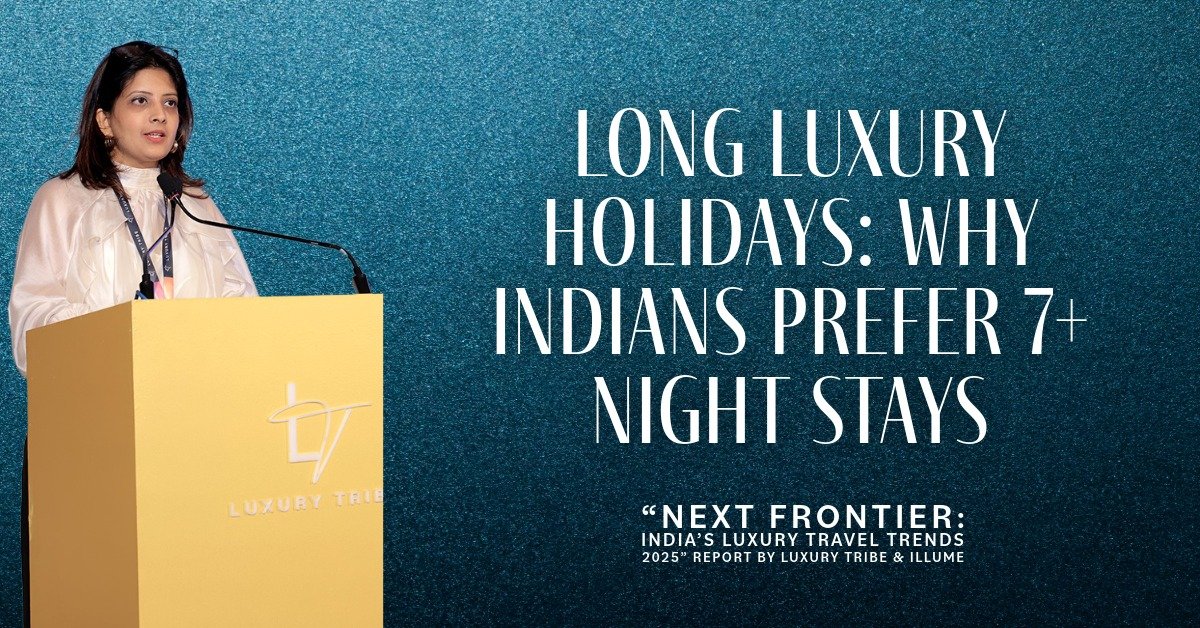
The Rise of the Long Stay: Why Depth Beats Frequency for Indian UHNWIs
Analysis from report: “Next Frontier: India’s Luxury Travel Trends 2025” is the definitive industry report on the evolving preferences and spending behaviour of India’s affluent outbound traveller. Commissioned and published by Luxury Tribe, this landmark report is grounded in exclusive insights gathered over three months through a structured survey of 120 of India’s most influential luxury travel designers—those who directly manage the bespoke travel plans of the country’s high-net-worth individuals and ultra-high-net-worth families.
This Analysis Covers
- 7+ night dominance
- “One meaningful journey > five short trips”
- What this means for hotels, DMCs, destinations
There is a quiet recalibration happening in Indian luxury travel—one that doesn’t show up in airline seat capacity or hotel ADR alone, but is visible in how affluent travellers are structuring time.
The “Next Frontier: India’s Luxury Travel Trends 2025” report suggests that longer stays (7+ nights) are a strong preference among affluent Indian travellers, and that a majority follow a mixed pattern—choosing longer or shorter formats based on trip purpose rather than a fixed habit.
This is more than a scheduling detail. Trip length is a behavioural indicator. It reveals what the traveller values most: immersion, privacy, production-quality celebration, and emotional restoration—none of which work well inside rushed, checklist itineraries.
In 2025, the most valuable journeys from India are increasingly built around a new logic: quality over quantity, depth over frequency.
1. Trip length is becoming purpose-led, not calendar-led
A useful starting point is the “Next Frontier: India’s Luxury Travel Trends 2025” report’s finding that the largest share of travellers follow a mixed travel pattern: they take longer or shorter trips depending on the reason for travel. This is a major shift away from uniform “annual holiday” behaviour and toward purpose-led travel design.
In practical terms, this means:
- short trips still happen—often city breaks, shopping-led escapes, or quick family visits,
- but long trips dominate when the purpose is high-value: celebration, privacy, remote experiences, multi-generational travel, or deep restoration.
The long stay is not replacing the short break. It is becoming the signature format for the journeys that matter most.
2. Why long stays are rising now: four drivers
2.1 Celebration travel expands the itinerary by default. Celebratory travel is one of the strongest secondary motivators in the “Next Frontier: India’s Luxury Travel Trends 2025” report. A milestone trip is rarely “three days and done.” It tends to include:
- arrivals of multiple family units,
- a central event moment,
- pre- and post-celebration time,
- and often a second location layered in for contrast.
Celebrations turn the journey into a production, and production requires time. Long stays are not indulgence; they are logistics.
2.2 Remote luxury and safaris are time-dependent. Safaris and remote getaways rank as the top in-demand experience category in the “Next Frontier: India’s Luxury Travel Trends 2025” report, with adventure and nature exploration also highly relevant. The defining feature of these journeys is that they cannot be compressed without losing meaning.
You don’t “do” a safari in two nights and retain its emotional payoff. Wilderness luxury requires:
- acclimatisation,
- pacing,
- repeated experiences across different times of day,
- and the kind of unhurried rhythm that creates psychological reset.
The rise of wild-luxe travel naturally produces longer formats.
2.3 Privacy needs create a preference for “settling in”. The “Next Frontier: India’s Luxury Travel Trends 2025” report highlights seclusion and privacy as a key influence on trip length and destination selection. Privacy isn’t only about being away from crowds; it often becomes a preference for stability: one secure base, one controlled environment, one trusted team.
When travellers value privacy, they often prefer to:
- move less frequently,
- settle into a property that understands them,
- and reduce the exposure that comes with transitions.
A long stay supports the privacy mindset better than constant movement.
2.4 Restoration is now a luxury outcome. Leisure and relaxation is the dominant motivator in the “Next Frontier: India’s Luxury Travel Trends 2025” report, confirming that indulgence and decompression remain the baseline of luxury travel demand.
But restoration has matured. For many affluent Indian travellers, the goal is not “time off.” It is:
- recovery from intensity,
- rebalancing of health and sleep,
- family togetherness without daily city pressure,
- and a feeling of renewed control.
These outcomes require time. Restoration is not instantaneous.
3. The long stay is not always “one destination”—it is often “one base”
An important nuance: long stays don’t always mean one place. They often mean one anchor property with layered experiences. Because accommodation spend remains the largest allocation in luxury travel budgets, the property becomes a secure base—what the traveller invests in first.
From there, the long-stay journey is designed as:
- private day journeys,
- curated excursions,
- controlled cultural access,
- and experiences that feel bespoke—but without repeated packing, moving, and re-checking-in.
This helps explain why suite upgrades remain the most demanded add-on: the suite is not just a bigger room; it becomes a private headquarters for the entire journey.
Illume Insight: In 2025, India’s highest-value luxury trips are designed for depth: fewer journeys, longer stays, and experiences that unfold slowly—by intention, not convenience.
4. What long-stay demand signals about the Indian luxury traveller
Trip length is an underused diagnostic. Longer formats signal three behavioural truths.
Truth #1: The Indian luxury traveller is increasingly “experience-first”. The “Next Frontier: India’s Luxury Travel Trends 2025” report shows unique experiences as a strong influence on destination selection, and experience-led holiday types rising in demand. When experience is the goal, time becomes necessary.
Truth #2: Luxury is shifting from spectacle to quality-of-life
Long stays are not designed for maximal sightseeing. They’re designed for:
- better sleep,
- better privacy,
- better family rhythm,
- better food routines,
- better wellness integration,
- and fewer points of friction.
This is luxury as quality-of-life, not luxury as performance.
Truth #3: Trust is concentrating around fewer partners. Long-stay journeys tend to be built around trusted advisors, trusted brands, and properties known for consistency. This aligns with the “Next Frontier: India’s Luxury Travel Trends 2025” report’s repeated signals around accommodation dominance, suite preference, and privacy needs.
In other words, long stays reward brands that can earn—and hold—trust.
5. What brands should do differently: long-stay readiness is now a competitive advantage
If you want to capture India’s highest-value travellers, you don’t only need premium inventory. You need long-stay readiness—a capability stack.
For hotels and resorts: redesign “extended stay” as a luxury product. Long stays are not won with discounts. They are won with:
- suite and villa-led living,
- multi-bedroom options,
- privacy controls,
- on-property variety (wellness, dining, experiences),
- and concierge orchestration that keeps each day distinct without feeling busy.
The “Next Frontier: India’s Luxury Travel Trends 2025” report’s accommodation selection factors reinforce the importance of luxury amenities and proximity, with privacy as an important expectation. Long-stay products should be built on this triad.
For DMCs: build fewer moves, deeper experiences. Long-stay travellers often prefer:
- fewer hotel changes,
- higher quality excursions,
- and stronger personalisation.
Given the “Next Frontier: India’s Luxury Travel Trends 2025” report’s emphasis on unique experiences, DMCs that can design “deep days” (rather than packed itineraries) will win this segment.
For destinations and tourism boards: sell “time,” not “top 10 things”. The classic destination brochure logic is activity-heavy. But long-stay demand is built on mood and rhythm:
- the feeling of settling in,
- the ease of repeatable pleasures,
- and a set of signature moments that create story.
Destinations should position themselves as places where luxury travellers can live well, privately, for longer—not just visit.
6. The emerging “Long-Stay Map”: where this trend is most naturally expressed
The long-stay format pairs best with destinations that offer one or more of the following:
- a strong luxury villa and resort ecosystem,
- a high-trust service culture,
- layered experiences accessible without constant movement,
- and privacy-by-design.
This connects to multiple destination signals in the “Next Frontier: India’s Luxury Travel Trends 2025” report —continued strength of classic hubs (Europe), plus the rise of safari and remote geographies that demand longer pacing.
Executive takeaway
The long stay is not a travel pattern. It is a worldview. It suggests that India’s highest-value travellers are increasingly choosing:
- fewer journeys,
- longer formats,
- deeper personalisation,
- and luxury experiences that unfold slowly, with control and ease.
For brands, the implication is clear: long-stay readiness is no longer optional. It is becoming the most reliable gateway to capturing India’s most consequential travel spend. “Next Frontier: India’s Luxury Travel Trends 2025”
Read Next Analysis: Seclusion with Service: The New Privacy Equation for Indian UHNWIs
Read Previous Analysis: Destination Celebrations: India’s Highest-Spend Travel Driver
Explore the Report: /Next-Frontier-India-s-Luxury-Travel-Trends-2025/
Download the full report: email signup request
The insights, data interpretations, and perspectives presented in this article and report are proprietary to “Luxury Tribe & Illume”. They may be quoted or referenced by media and partners for editorial or analytical purposes, provided clear attribution is given to: Source: “Next Frontier: India’s Luxury Travel Trends 2025” Report by Luxury Tribe & Illume. Reproduction, redistribution, or commercial use of this material, in whole or in part, without prior written consent from Luxury Tribe, is not permitted.
Copyright © 2009-2025. Proprietary insights by Kaltenhouse Pte Ltd. All Rights Reserved.