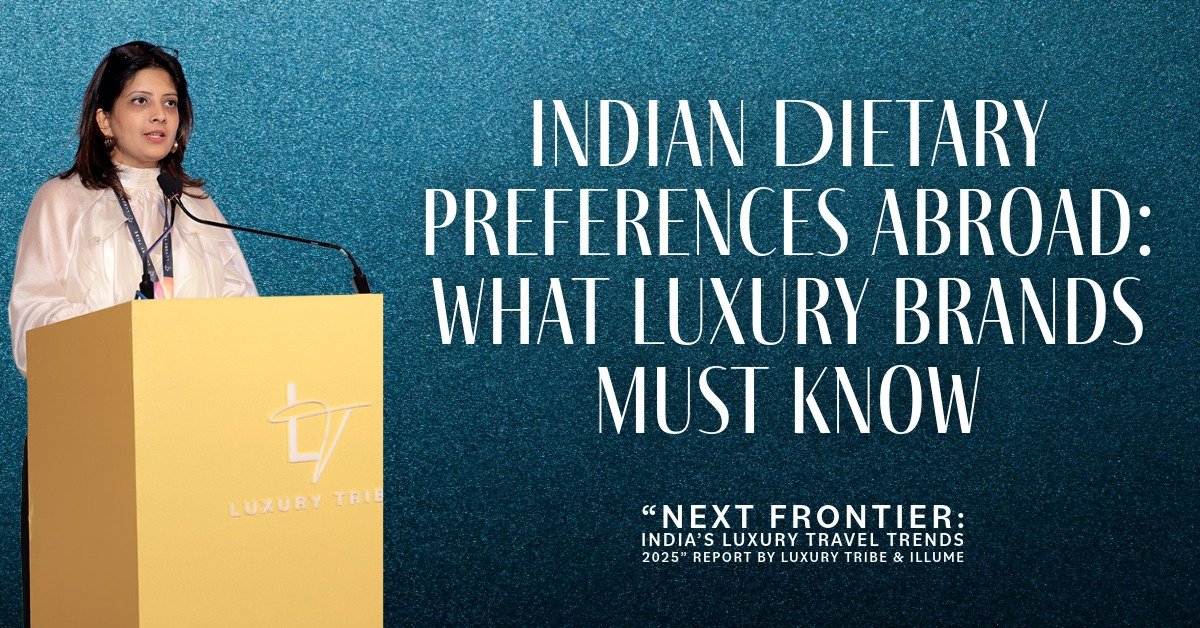
Food, Faith, Flexibility: How Indian Dietary Preferences Are Evolving
Analysis from report: “Next Frontier: India’s Luxury Travel Trends 2025” is the definitive industry report on the evolving preferences and spending behaviour of India’s affluent outbound traveller. Commissioned and published by Luxury Tribe, this landmark report is grounded in exclusive insights gathered over three months through a structured survey of 120 of India’s most influential luxury travel designers—those who directly manage the bespoke travel plans of the country’s high-net-worth individuals and ultra-high-net-worth families.
This Analysis Covers
- Vegetarianism vs rigidity
- Why “optionality” beats “Indianisation”
- Culinary exploration as confidence
For years, one assumption has quietly shaped how global luxury brands think about India: “If you want Indian UHNWIs, make sure you can serve Indian food.”
The “Next Frontier: India’s Luxury Travel Trends 2025” report suggests a more sophisticated reality. Yes—dietary preferences matter. A significant share of respondents rate dietary availability as important or very important in travel decisions. Vegetarian preferences remain highly relevant, and Jain requirements remain critical for a select subset.
But the “Next Frontier: India’s Luxury Travel Trends 2025” report also reveals a shift that many brands underestimate: a strong majority of affluent Indian travellers are open to trying local cuisines, and Indian cuisine is not requested as frequently as global stereotypes suggest.
In other words, the Indian luxury traveller is not becoming “less Indian.” They are becoming more globally fluent—while still requiring specific food assurances when it matters. This analysis breaks down what is changing, what remains non-negotiable, and how luxury hotels, resorts, and destinations should respond without over-correcting.
1. The core insight: dietary preferences are relevant, but not always a dealbreaker
The “Next Frontier: India’s Luxury Travel Trends 2025” report finds that many respondents view dietary availability as “important” or “very important,” with a substantial proportion also placing it in the “somewhat important” category. A smaller segment indicates it is “not important.”
This distribution is revealing because it tells us dietary needs operate like risk management:
- For some travellers, it is essential.
- For many, it is comforting.
- For a meaningful minority, it is irrelevant.
That means brands should not treat “Indian dietary needs” as one monolithic requirement. Instead, they should treat it as a confidence layer—something that reduces uncertainty and increases comfort, without needing to dominate the narrative.
2. The biggest myth: “Indian luxury travellers only eat Indian food abroad”
The “Next Frontier: India’s Luxury Travel Trends 2025” report indicates that most affluent Indian travellers are willing to explore local cuisines, and that Indian cuisine itself is not as frequently demanded as many assume.
This is a significant signal. It suggests that the new Indian luxury traveller—particularly at the HNWI and UHNWI level—is increasingly:
- internationally exposed,
- curious,
- and confident in culinary exploration.
They do not necessarily want Indian food everywhere. They want assurance that if they need something specific, it can be done discreetly and well.
Executive interpretation: Indian travellers are not asking for cultural replication. They are asking for respectful optionality.
3. What remains structurally important: vegetarian excellence
While Indian cuisine requests may be lower than expected, vegetarian preferences remain highly relevant in the “Next Frontier: India’s Luxury Travel Trends 2025” report’s findings. But vegetarianism, in luxury contexts, is often mishandled. The expectation is not: “Can you serve a vegetarian dish?”
The expectation is: “Can you serve vegetarian food with the same imagination, depth, and pride as your signature menu?” For Indian UHNWIs, vegetarian support becomes a proxy for:
- the competence of the kitchen,
- the respect shown to the guest,
- and the property’s ability to handle preferences without making them feel inconvenient.
In luxury travel, how you handle food requirements is often more important than the requirement itself.
4. Jain and specific Indian meal needs: niche but critical
The “Next Frontier: India’s Luxury Travel Trends 2025” report indicates that Jain meal requests exist as a smaller segment—yet they are high-stakes. This is where many global luxury properties lose trust. Not because they can’t fulfil the request—but because they treat it casually, or misunderstand its seriousness.
For a Jain guest, food is not taste—it is faith and practice. The brand’s ability to handle Jain requirements quietly and precisely often determines whether:
- the guest returns,
- the family recommends,
- and the travel designer trusts the property again.
Operational truth: Jain readiness doesn’t need to be loud marketing. It needs to be quiet capability: trained staff, clear kitchen protocols, and zero awkwardness.
Illume Insight: The new Indian luxury traveller is not defined by needing Indian food abroad. They are defined by expecting confidence: excellent vegetarian options, respectful flexibility, and zero friction when preferences matter.
5. Why food expectations are changing now: three drivers
5.1 Global exposure is rising. As Indian affluent travellers expand their travel circuits, food becomes part of cultural confidence. This aligns with the “Next Frontier: India’s Luxury Travel Trends 2025” report’s broader signal that cultural familiarity ranks low as a destination-selection factor. Luxury travellers want the world, not a replica of home—provided their needs are respected.
5.2 Experience-led travel is creating culinary curiosity. With unique experiences and adventure/exploration rising, food becomes part of the story. It is no longer only sustenance; it is a curated cultural layer—particularly in destinations where gastronomy is a status language. This connects to the “Next Frontier: India’s Luxury Travel Trends 2025” report’s observation that Michelin-star dining and private culinary experiences appear as aspirational upgrades.
5.3. The “comfort requirement” has moved from cuisine to certainty. In earlier phases of Indian outbound travel, comfort was created by familiarity. In 2025, comfort is increasingly created by certainty:
- the certainty that vegetarian options will be excellent,
- the certainty that Jain needs can be met,
- the certainty that preferences won’t become a negotiation.
This is a maturity signal.
6. What luxury brands should do: a three-tier food strategy
The correct response to this evolution is not “add an Indian restaurant.” A smarter model is a three-tier strategy:
Tier 1: Vegetarian excellence by default. Not an extra menu. Not one token dish. A full set of vegetarian options built with craft, pride, and strong sourcing. This meets the largest practical need without turning the property into an “Indianised” experience.
Tier 2: Jain and specific Indian requirements on confident request. Build a discreet operational pathway:
- trained team,
- clear kitchen protocol,
- ingredient control,
- and the ability to deliver without drama.
This is not mass-demand, but it is high-stakes demand.
Tier 3: Culinary exploration positioned as luxury access. For travellers who are open to local cuisine, elevate the experience:
- chef-led tastings,
- private dining moments,
- market visits with cultural context,
- and behind-the-scenes access that makes food feel like “entry,” not consumption.
This aligns with the access-driven luxury shift and supports the “Next Frontier: India’s Luxury Travel Trends 2025” report’s signals on experiential travel.
7. The bigger implication: food is a trust metric, not a cuisine request
In the Indian luxury market, dining isn’t simply a service category. It is a trust metric. If the guest feels their preferences are:
- misunderstood,
- minimised,
- or treated as inconvenient,
the brand loses credibility quickly—especially through travel designers who remember operational failures more than décor.
Conversely, when a property handles dietary needs with ease, the guest perceives:
- competence,
- cultural intelligence,
- and high-touch service.
And that perception often influences everything else: overall satisfaction, repeat intent, and word-of-mouth.
Executive takeaway: Indian luxury travellers are becoming more globally adventurous in what they eat—but they still require certainty and respect where dietary preferences matter. The opportunity for global luxury brands is not to “Indianise” the experience.
It is to deliver:
- vegetarian excellence,
- Jain optionality with precision,
- and culinary exploration as a curated luxury experience—
without friction, without fuss, and without making the guest feel like an exception. That is the new food code for Indian luxury travel in 2025. “Next Frontier: India’s Luxury Travel Trends 2025”
Read Next Analysis: The New Source Markets: Why Luxury Demand Is Rising Beyond Metro India
Read Previous Analysis: Hotels Still Matter Most: How Indian Luxury Budgets Are Really Spent
Explore the Report: “Next Frontier: India’s Luxury Travel Trends 2025”
Download the full report: email signup request
The insights, data interpretations, and perspectives presented in this article and report are proprietary to “Luxury Tribe & Illume”. They may be quoted or referenced by media and partners for editorial or analytical purposes, provided clear attribution is given to: Source: “Next Frontier: India’s Luxury Travel Trends 2025” Report by Luxury Tribe & Illume. Reproduction, redistribution, or commercial use of this material, in whole or in part, without prior written consent from Luxury Tribe, is not permitted.
Copyright © 2009-2025. Proprietary insights by Kaltenhouse Pte Ltd. All Rights Reserved.