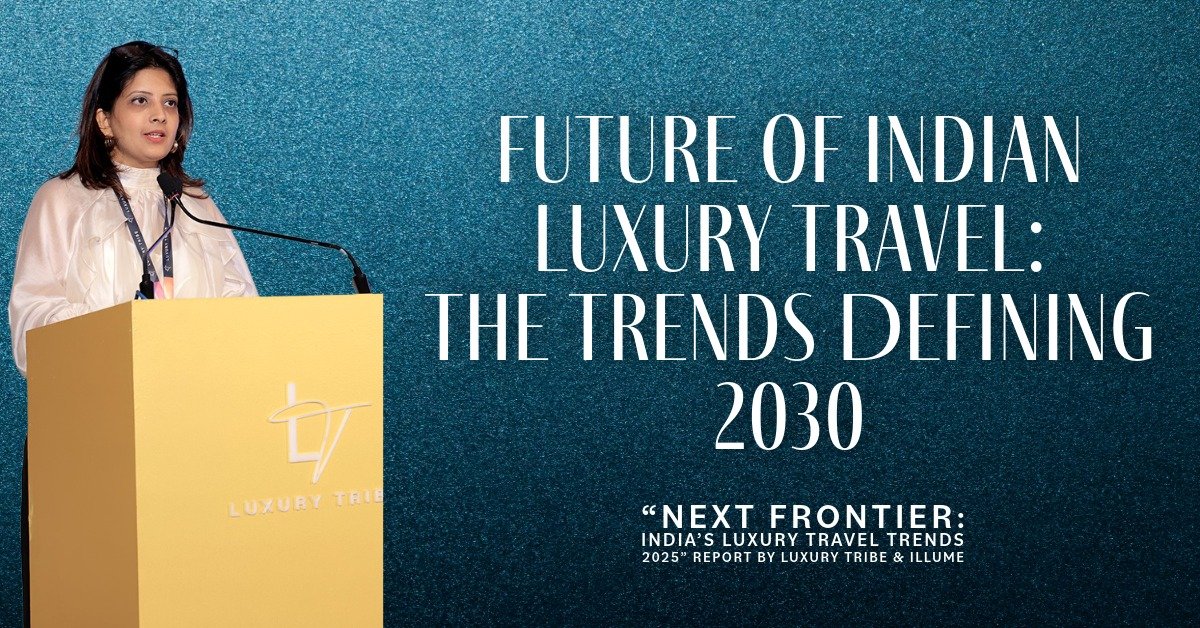
The Next Five Years: What Will Define Indian Luxury Travel by 2030
Analysis from report: “Next Frontier: India’s Luxury Travel Trends 2025” is the definitive industry report on the evolving preferences and spending behaviour of India’s affluent outbound traveller. Commissioned and published by Luxury Tribe, this landmark report is grounded in exclusive insights gathered over three months through a structured survey of 120 of India’s most influential luxury travel designers—those who directly manage the bespoke travel plans of the country’s high-net-worth individuals and ultra-high-net-worth families.
This Analysis Covers
- Offbeat over iconic
- Wellness as restoration, not indulgence
- Tech-enabled discretion
- Sustainability without sacrifice
- The Indian traveller as a global equal, not an emerging market
Luxury travel is often analysed through destinations, airline classes, and hotel pipelines. But the most powerful shifts happen somewhere else: inside the traveller’s definition of what is valuable.
The “Next Frontier: India’s Luxury Travel Trends 2025” report captures the strongest behavioural signals of Indian luxury travel in 2025—privacy as a requirement, celebration-led journeys as a high-spend engine, longer stays as an emerging preference, wild-luxe as a new prestige format, and the decentralisation of demand beyond metro India.
This final analysis looks forward. Not to predict the future in a speculative way, but to extrapolate what is already visible in the data: what will likely define Indian luxury travel by 2030, and what global brands must build now if they want to remain relevant.
1. Luxury will shift further from “things” to “conditions”
The “Next Frontier: India’s Luxury Travel Trends 2025” report findings already suggest that luxury, for India’s affluent traveller, is less about visible opulence and more about the conditions in which life can be lived while travelling. Conditions such as:
- privacy without inconvenience,
- service without friction,
- access without crowds,
- and time without pressure.
Accommodation remains the dominant spend category in the “Next Frontier: India’s Luxury Travel Trends 2025” report, and suite upgrades top the list of demanded add-ons—signals that travellers will continue to invest heavily in the environment that holds the journey together.
By 2030, this logic will deepen:
- the suite becomes the “private residence” standard,
- the villa becomes a mainstream luxury format for families,
- and privacy infrastructure becomes a baseline expectation, not a differentiator.
2. The new luxury advantage will be networks, not marketing
One of the most important shifts visible today is the access-led turn: Indian affluent travellers increasingly value unique experiences and exclusive moments that cannot be booked publicly. This will intensify.
By 2030, brands will be judged less by how they advertise and more by what they can unlock:
- closed-door cultural access,
- rare permissions,
- limited-capacity nature moments,
- private previews and behind-the-scenes experiences.
In other words, access will become a moat—and moats are built through relationships, not campaigns. This aligns with the series’ earlier observation: when premium becomes widely available, entry becomes the differentiator.
3. Celebration-led travel will become more structured—and more discreet
Celebratory travel is already a major motivator in 2025. But by 2030, it will likely evolve in two directions:
3.1 More structured. Families will increasingly expect:
- event-level run-of-show planning,
- multi-location celebration arcs,
- precision on privacy, food, and guest movement,
- and seamless production value without obvious effort.
3.2 More discreet. As wealth grows, the appetite for loud spectacle often reduces. What rises instead is taste-led celebration:
- fewer guests, higher quality,
- private venues,
- controlled visibility,
- and experiences that feel personal rather than performative.
The brands that win celebration travel by 2030 will be those that can deliver discreet orchestration—not just beautiful backdrops.
4. Long stays will become the default format for “high-value travel”
The “Next Frontier: India’s Luxury Travel Trends 2025” report suggests that longer stays (7+ nights) are a strong preference, especially when the purpose of travel is meaningful. That trend is likely to strengthen further. By 2030, the most consequential Indian luxury journeys will increasingly:
- be longer,
- include fewer moves,
- and be built around one strong base with layered private experiences.
The reason is simple: the modern luxury outcome is restoration and depth. Those outcomes require time. The growth of long stays will also reshape how destinations compete. The winners will be places that can offer:
- variety without constant movement,
- privacy without remoteness,
- and experiences that unfold across days rather than being consumed in hours.
5. Wild-luxe will expand beyond safaris into a broader “frontier portfolio”
Safaris and remote getaways rank as the top in-demand experience category for 2025 in the “Next Frontier: India’s Luxury Travel Trends 2025” report, reflecting a strong pull toward wilderness luxury and rare landscapes. By 2030, this will likely broaden into a frontier portfolio:
- safari luxury becomes more specialised (private reserves, conservation-linked stays),
- polar and phenomenon travel grows (Northern Lights, Arctic formats),
- expedition cruising becomes a status circuit,
- and remote lodge ecosystems expand in relevance.
The defining feature is not “adventure.” It is controlled rarity:
- small inventory,
- high story value,
- and privacy built into the geography.
This is the new prestige: distance from the world, delivered with comfort and competence.
Illume Insight: By 2030, India’s luxury traveller won’t be defined by aspiration. They’ll be defined by discernment—privacy-by-design, access-by-network, and journeys built around restoration, not accumulation.
6. Wellness will shift from indulgence to restoration—and become more outcome-driven
Wellness is often treated as spa amenities. But the deeper behaviour is emerging: affluent travellers increasingly want restoration—sleep, recovery, recalibration, and mental quiet.
This aligns with the “Next Frontier: India’s Luxury Travel Trends 2025” report’s baseline motivator: leisure and relaxation dominates demand. But by 2030, relaxation will mature into intentional restoration, especially for high-intensity founders, family business leaders, and globally mobile professionals.
What this means for luxury brands:
- wellness will become less about treatments and more about programmes,
- less about “pampering” and more about outcomes,
- and increasingly integrated into the stay (food, movement, sleep systems, quiet design).
The brands that win will be those who can offer wellness without turning the experience clinical—restoration, not medicalisation.
7. Food expectations will mature into “optionality with excellence”
The “Next Frontier: India’s Luxury Travel Trends 2025” report suggests most affluent Indian travellers are open to exploring local cuisines, while vegetarian preferences remain important and Jain requirements are critical for a subset.
By 2030, the winning model will be clear:
- not Indianisation,
- but optionality with excellence.
Luxury brands will be expected to deliver:
- vegetarian food with genuine culinary ambition,
- Jain requirements with quiet competence,
- and local cuisine experiences curated as cultural access.
Food will increasingly function as a trust metric: if you can handle preferences without friction, the guest assumes you can handle everything else too.
8. Sustainability will matter—but only when it doesn’t feel like sacrifice
Sustainability is often discussed loudly, but luxury travellers adopt it selectively. By 2030, the Indian luxury traveller will likely embrace sustainability when it appears as:
- better design,
- better sourcing,
- better conservation-linked experiences,
- and better long-term value—
not when it appears as reduced comfort. This is a “no compromise” market. Sustainability will be rewarded when it is integrated seamlessly into luxury—not positioned as an alternative to it.
9. The growth engine will be decentralised India + global Indian networks
The “Next Frontier: India’s Luxury Travel Trends 2025” report highlights the rise of Tier-2 and Tier-3 source markets. By 2030, this decentralisation will likely accelerate, creating a broader and more diverse outbound luxury base.
At the same time, global Indian networks (diaspora-linked travel patterns, international family structures, cross-border education and work) will shape:
- multi-city travel rhythms,
- longer stays,
- and celebration travel that gathers family across continents.
For global brands, this means India strategy will require both:
- geographic expansion within India, and
- stronger network fluency across global Indian communities.
Executive takeaway: what will define Indian luxury travel by 2030. By 2030, Indian luxury travel will be defined less by aspiration and more by discernment. The winning travel propositions will deliver:
- privacy-by-design (not promised, engineered),
- access-by-network (entry, not availability),
- celebration capability (orchestration with discretion),
- long-stay readiness (depth over frequency),
- wild-luxe frontiers (rarity as prestige),
- restoration wellness (outcomes without clinical tone),
- food optionality (vegetarian excellence + Jain competence),
- and a decentralised India growth engine (Tier-2 trust-first acquisition).
The brands that act now will not simply “capture India.” They will help shape how India’s luxury traveller is understood globally—on equal terms, with a distinct behavioural identity. That is the next five years. “Next Frontier: India’s Luxury Travel Trends 2025”
Read Next Analysis: The Indian Luxury Traveller, Rewritten: What Has Fundamentally Changed
Read Previous Analysis: The New Source Markets: Why Luxury Demand Is Rising Beyond Metro India
Explore the Report: “Next Frontier: India’s Luxury Travel Trends 2025”
Download the full report: email signup request
The insights, data interpretations, and perspectives presented in this article and report are proprietary to “Luxury Tribe & Illume”. They may be quoted or referenced by media and partners for editorial or analytical purposes, provided clear attribution is given to: Source: “Next Frontier: India’s Luxury Travel Trends 2025” Report by Luxury Tribe & Illume. Reproduction, redistribution, or commercial use of this material, in whole or in part, without prior written consent from Luxury Tribe, is not permitted.
Copyright © 2009-2025. Proprietary insights by Kaltenhouse Pte Ltd. All Rights Reserved.